Wednesday, 17 January 2018

Pros and Cons of Buying a Used Car from a Private Party Seller


When buying a used vehicle, most consumers choose to purchase from a dealership or a private party seller. A private party seller is an individual just like you, someone who owns a vehicle that they need to sell, and who is likely selling the vehicle themselves in order to extract maximum value for it.


There are several pros and cons of buying a used car from a private party seller. In the sections that follow, this article discusses the most significant of them.


Pro: Private Party Vehicles Cost Less
Conventional wisdom says that there are three values for a used vehicle: Trade-in, private party, and retail. In recent years, a new value has emerged at the top of the scale to cover certified pre-owned (CPO) vehicles. Of the four value ranges, the private party value is on the lower end of the scale.


Used vehicles sold by dealers cost more than used vehicles sold by private parties. That's because the dealer must cover the costs of reconditioning the vehicle, of advertising the vehicle, and of paying a salesperson a commission. Additionally, the dealer shoulders the administrative costs related to the purchase of the vehicle from the previous owner and related to the sale of the vehicle to the new owner.


A private party seller need not worry about this profit-killing overhead. Additionally, a private party seller is usually more eager to sell the vehicle as soon as is possible, and is typically more flexible on price during negotiation.


Pro: Clean, Well-Maintained Vehicles
Not all private party vehicles are in good condition. Some are even salvage vehicles, which means they've been repaired after a wreck, flood, or theft. This is why it is always smart to obtain an official vehicle history report for any used vehicle you're planning to purchase.


That said, a private party seller who has taken great care of a vehicle and who has all of the maintenance and service records for the vehicle is likely to try to sell it on their own. Owners who take such pride in their vehicle are less inclined to accept a dealer's trade-in offer, believing the car is worth hundreds, or thousands, of dollars more if they sell it themselves.


As a used-vehicle buyer, this is a benefit. The seller is likely interested primarily in receiving more money for the vehicle than the dealer offered them as a trade-in, while the buyer is able to purchase a clean, well-maintained used car at a big discount compared to what the same vehicle might sell for at a used car dealer.


Pro: No Games
Generally, private party sellers are in a hurry to sell their old vehicle, and if you demonstrate that you are a serious buyer, they are more likely to want to get the transaction completed quickly and with you. This is particularly true of owners who are selling popular models in popular colors because they have more market competition than people who are selling more rare models. This eagerness means private party sellers are less likely to play games with serious buyers, making it easier to negotiate, agree on terms, and get the transaction completed.


Con: Multiple Meetings with Strangers
Buying a used vehicle from a private party seller requires meetings with strangers to test-drive the vehicle, have the vehicle inspected, and to complete the transaction for the vehicle. The majority of the time, this is not a concern. Nevertheless, it is wise to always arrange meetings in busy public places, rather than at the seller's home, at your home, or in a secluded area.


Con: No Warranty or Guarantee
Used car dealers must abide by Federal Trade Commission rules as well as state regulations governing how they operate and sell vehicles. Additionally, dealers often "certify" their used vehicles, frequently provide short-term warranties, and sometimes offer a money-back guarantee. As a result, dealers generally sell only those used vehicles that are in good condition.


Used vehicles sold by private party sellers come with no warranty or guarantee of any kind, and are not certified in any way. When purchasing a used vehicle from a private party seller, the buyer must perform due diligence in the form of obtaining vehicle history reports, paying for professional inspections, and conducting a thorough test drive in order to make sure they're not making a purchase they may soon regret.


Con: Details, Details, Details
Buy a used vehicle, such as the used Hyundai ix35 for sale, from a dealer, and the dealer takes care of all the paperwork associated with the transfer of ownership, can help arrange financing if necessary, and can even buy your old car as a trade-in. Buy a used vehicle from a private party seller, and those details are the buyer's responsibility. You will also need to sell your old vehicle yourself, making you the private party seller in this scenario.

Article source: http://www.jdpower.com/cars/articles/used-cars/pros-and-cons-buying-used-car-private-party-seller

Monday, 8 January 2018

2017 Hyundai Tucson: New Car Review


In the 2017 Hyundai Tucson, you'll find a very stylish compact SUV with a choice of two fuel-efficient engines, available all-wheel drive and a long list of features to meet just about any need. Although newer rivals like the Honda CR-V and Mazda CX-5 offer a bit more in terms of fuel economy, ride and handling, the Tucson can tout its available turbocharged engine, excellent resale values and impressive standard 10-year/100,000-mile powertrain warranty. Yet while the Tucson has proven itself worthy on paved roads, it can't really tackle off-road obstacles in the same manner as the Jeep Cherokee Trailhawk or Subaru Forester, something to consider if you do a lot of outdoor activities.

What's New for 2017?

For 2017, the Limited trim gains Apple CarPlay and Android Auto, plus a 315-watt Infinity sound system. Sport and Eco trims receive rear-seat air vents, and the YES Essentials stain-resistant fabric is expanded to cover all interior colors.

What We Like

Lots of features; a wide range of standard and optional safety equipment; a smooth ride; stylish interior and exterior

What We Don't

Pricing a bit high compared to rivals; rather dull driving experience; desirable features like Apple CarPlay and navigation reserved for the most expensive trim

How Much?

$23,595-$35,000

Fuel Economy

The Tucson offers two power plants. Base-level SE models use a 164-horsepower 2.0-liter 4-cylinder engine, which comes with a 6-speed automatic transmission and front- or all-wheel drive. Front-wheel-drive models return 23 miles per gallon in the city and 30 mpg on the highway, while opting for all-wheel drive (AWD) drops gas mileage numbers to 21 mpg city/26 mpg hwy.
All other Tucson trim levels are powered by a new 175-hp 1.6-liter turbocharged 4-cylinder, which is mated to an impressively smooth 7-speed dual-clutch automatic transmission. Fuel economy with this engine tops out at 25 mpg city/30 mpg hwy with front-wheel drive, 24 mpg city/28 mpg hwy with AWD or, if you opt for the fuel-saving Tucson Eco, 26 mpg city/32 mpg hwy with front-wheel drive and 25 mpg city/30 mpg hwy with AWD.

Standard Features & Options

The Tucson is offered in four trim levels: the base-level SE, fuel-saving Eco, midlevel Sport and upscale Limited.
The Tucson SE ($23,595, FWD) ($24,995, AWD) is fairly basic, though it includes a few useful convenience features. Standard equipment includes a backup camera, YES Essentials stain-resistant fabric seat covers, air conditioning, 17-in alloy wheels, a tilt-telescopic steering column, Bluetooth, SiriusXM radio and a USB port for an iPod -- all items that are also included in most of the car's rivals. The SE also comes standard with the Tucson's mediocre base-level 2.0-liter engine.
The fuel-saving Eco ($25,045, FWD) ($26,445, AWD) only adds a few extras, such as a chrome dual exhaust, rear-seat air vents, Drive Mode Select, and a power driver's seat with power lumbar support and turn signals built into the side mirrors. Its main benefit is the addition of the Tucson's 1.6-liter turbocharged 4-cylinder engine and 7-speed dual-clutch automatic, along with a few extra fuel-saving modifications to improve gas mileage.
Up next is the midlevel Tucson Sport ($26,795, FWD) ($28,195, AWD), which adds 19-in alloy wheels, a blind spot monitoring system with rear cross-traffic alert, lane-change assist, heated front seats, a leather-wrapped steering wheel, a hands-free power lift gate and a proximity key with push-button start.
Topping the range is the high-end Tucson Limited ($30,670, FWD) ($32,070, AWD), which boasts an 8-in touchscreen with navigation, 315-watt Infinity audio with Apple CarPlay and Android Auto, leather upholstery, a power passenger seat, LED headlights, automatic headlights, dual-zone automatic climate control, auto-dimming mirrors and Hyundai's Blue Link telematics system.
As for options, the Tucson has two major optional packages. The base-level SE can be equipped with the Popular Equipment package ($750), which adds a power driver's seat, LED running lights, illuminated vanity mirrors and a glove-box light.
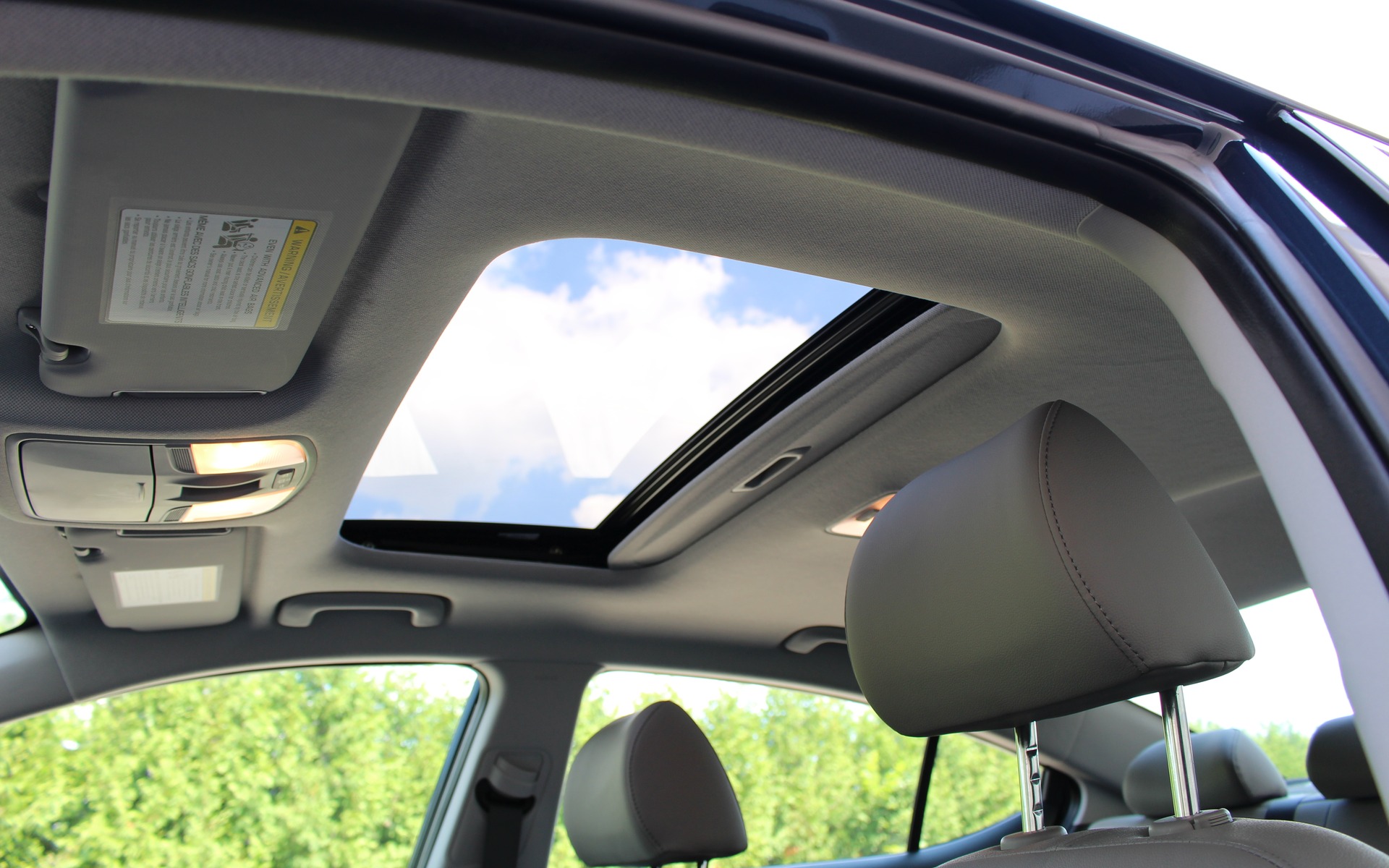
Meanwhile, the upscale Tucson Limited can add an even more luxurious Ultimate package ($2,750) that touts an LCD gauge cluster, ventilated front seats, heated rear seats, a panoramic sunroof, rear parking sensors, lane-departure warning, an automatic braking system and adaptive xenon headlights.

Safety

The 2017 Hyundai Tucson offers virtually every modern high-tech safety feature you might expect from a car in this class. Standard features include side-curtain airbags, a backup camera and anti-lock brakes, while options include lane-departure warning, a blind spot monitoring system and a forward-collision prevention system with automatic braking.
In crash tests, the National Highway Traffic Safety Administration gives the 2017 Tucson its highest rating of 5 stars overall, with 5 stars in the front- and side-impact tests and 4 stars in the rollover test. The independent Insurance Institute for Highway Safety (IIHS) gives the Tucson its highest rating of Good in all crash tests and Superior in the crash avoidance and mitigation test, earning the model a Top Safety Pick award.

Behind the Wheel

On the road, the Tucson is something of a mixed bag, though we suspect most crossover shoppers will appreciate the majority of what it has to offer. The Tucson touts a comfortable ride, predictable handling and, if you opt for the 1.6-liter turbocharged engine (as most drivers will), a tremendously smooth engine-and-transmission combination. In all, we think the used Hyundai Tucson offers one of the most pleasurable, supple rides in the compact-crossover segment.
Where the "mixed bag" remark comes in is for drivers who enjoy spending time behind the wheel. The Tucson isn't especially fun to drive, as acceleration is mediocre with either engine, and steering -- while suitable for the Tucson -- isn't exactly exciting. So while we think most drivers will appreciate the Tucson for its comfortable, smooth ride, those looking to have fun will probably want to consider another model with more power and improved handling.

As for visibility, interior room and cargo space, we found the Tucson to be roughly on par with other models in its segment: It's not a standout, but it's far from being the worst in its class.

Article source: https://www.autotrader.com/car-reviews/2017-hyundai-tucson-new-car-review-261605

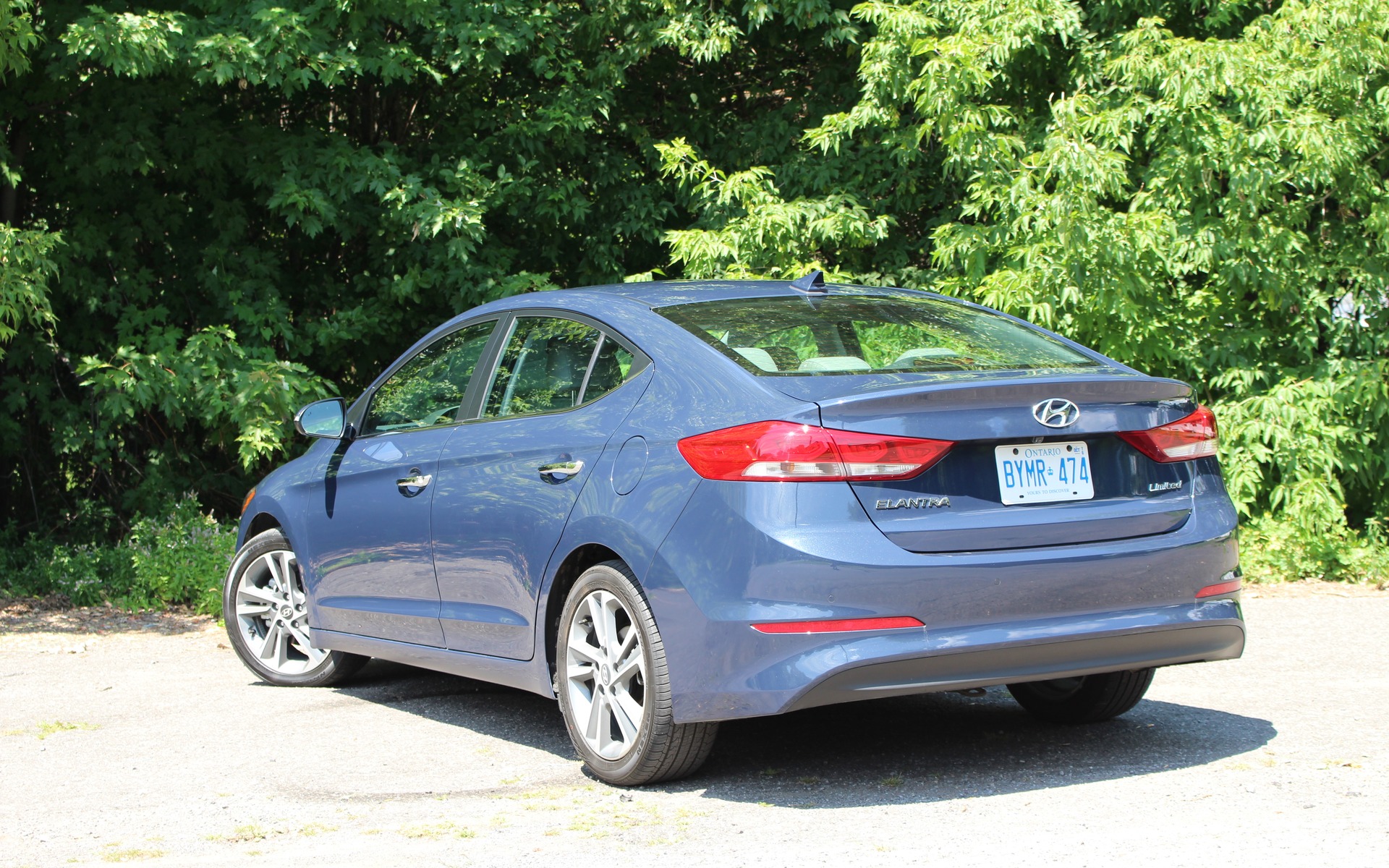
2017 Hyundai Elantra: Hitting the Mark Again


Compact cars are still very popular in Canada, but the segment is struggling of late because Canadian consumers are turning to small SUVs and crossovers, most of which offer the added safety of all-wheel drive.
And yet, with a good set of winter tires for the snowy season, a compact sedan can be practical, spacious enough for the family and fuel-efficient, too. The 2017 Hyundai Elantra is a perfect example and sales are pretty good, trailing behind powerhouses Honda Civic and Toyota Corolla, and ahead of the Volkswagen Golf/Jetta duo, the Chevrolet Cruze and the Mazda3.
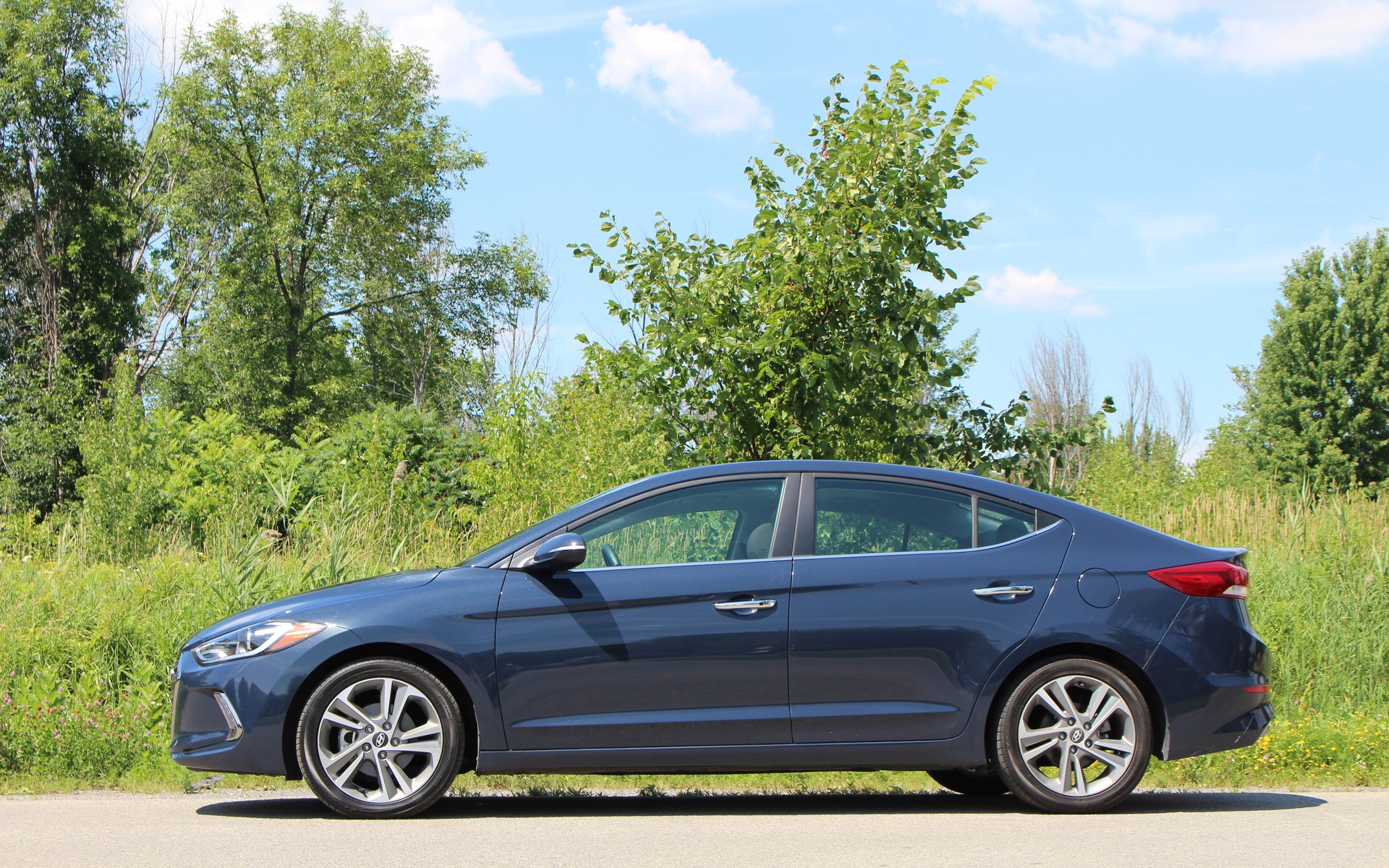
The used Hyundai Elantra sedan is built on a new platform composed of more high-strength steel. Hyundai proudly flaunts the fact that they produce their own metal in Korea, and that their sedan is both lighter and more rigid. It definitely feels stiff, despite being one the lightest sedans in its class.
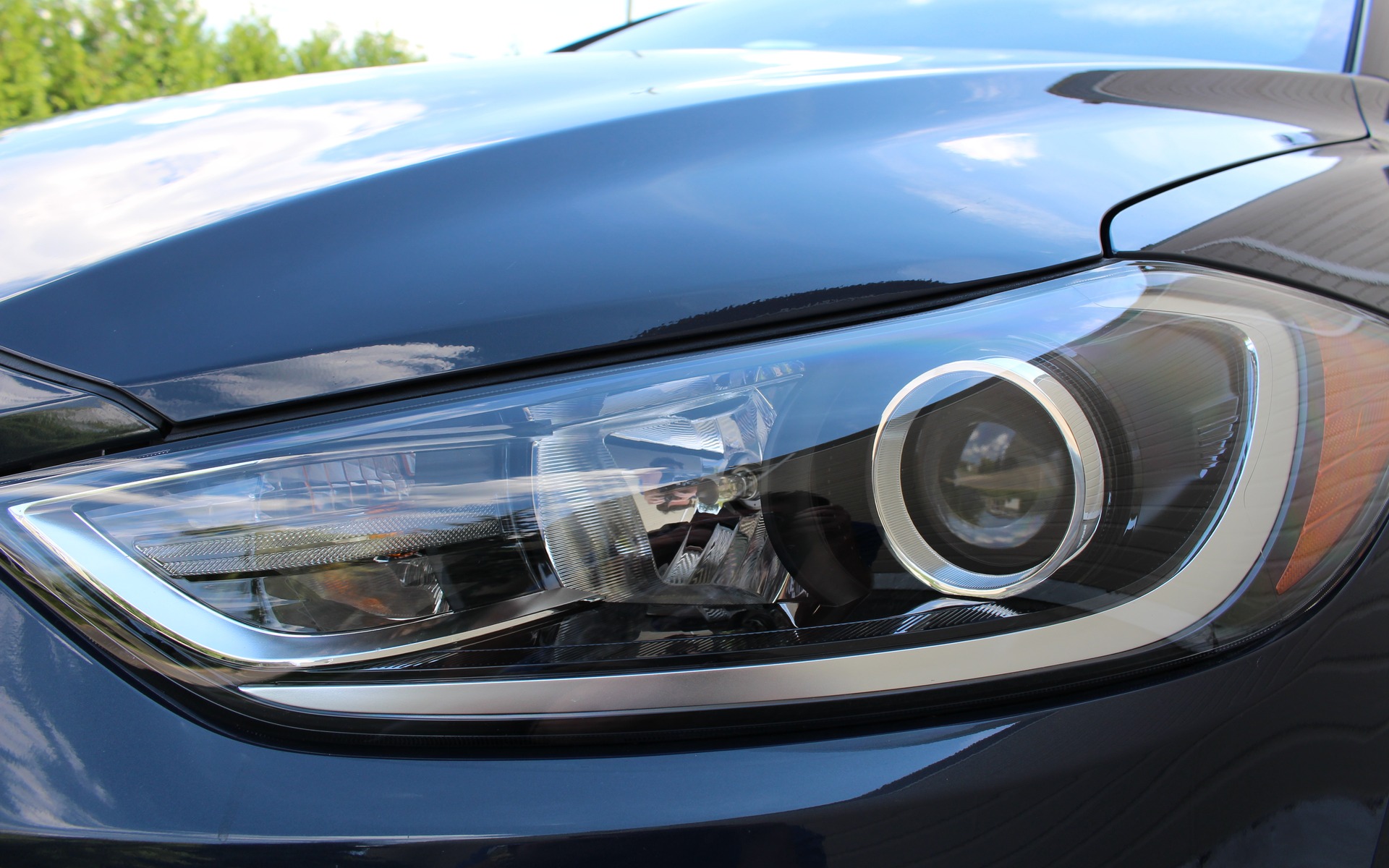
And although its new styling may not be as bold as when the previous-generation Elantra was unveiled for the 2011 model year, it’s angular and sophisticated, and will probably stand the test of time better. And apart from alloy wheels and LED exterior lighting, there are hardly any clues allowing us to distinguish the base trims from the loaded ones.

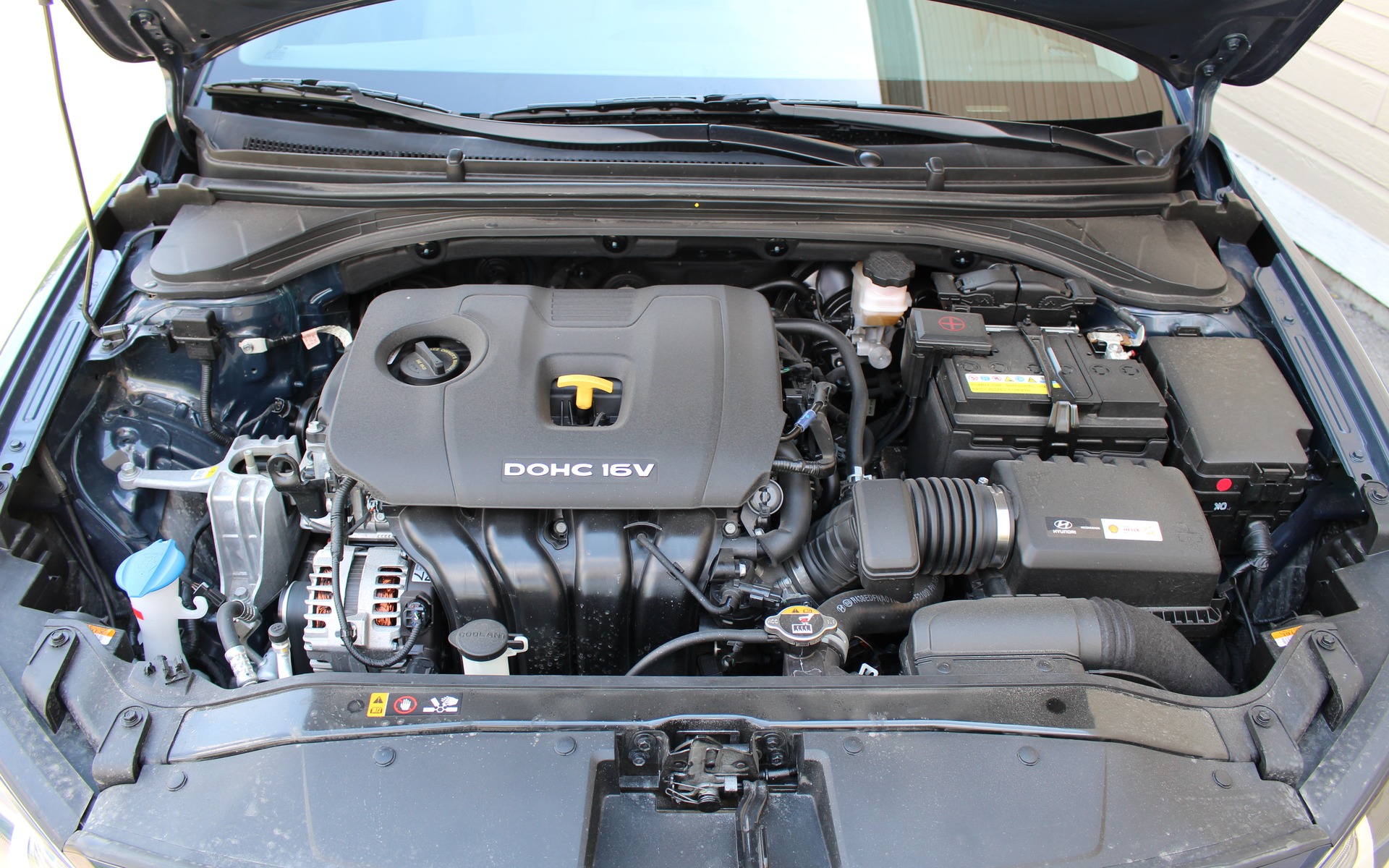
All versions of the 2017 Hyundai Elantra sedan, save for the recently introduced Elantra Sport, are equipped with the same powertrain. It’s a 2.0-litre, four-cylinder engine that runs on an Atkinson cycle instead of the usual Otto cycle. We’ll skip the technical explanation between the two, but the difference is that an Atkinson-cycle engine is usually more fuel efficient, but generally produces a little less power and torque. This type of combustion cycle is most seen in hybrid powertrains, as the electric motors provide assistance to compensate for the leaner output.
However, we’re now starting to see non-hybrid powertrains with Atkinson-cycle engines in production cars from Hyundai/Kia and Toyota. In the case of the Elantra, its engine produces 147 horsepower and 132 pound-feet of torque, which is actually not bad. The car offers decent performance, and definitely is as quick as a Corolla or a 2.0-litre Mazda3. During our test week, we averaged 7.5 L/100 km, which is pretty good for a compact sedan. However, its official fuel economy ratings fall about midpack its segment.
Engine technology aside, the Elantra feels refined, and its six-speed automatic transmission is a smooth performer. Note that a manual gearbox is still available in the base L trim and on the Sport, but every other variant of the Elantra sedan gets the automatic.
The car is also offers a refined and comfortable ride, thanks to the aforementioned rigidity of its platform and well-calibrated suspension. Bumps and road crevasses are easily absorbed, and when we’re behind the wheel of the Elantra, we generally feel like we’re driving a more expensive car. However, we can’t say it clearly stands out in such a competitive field; this might sound like a drawback, but really isn’t.
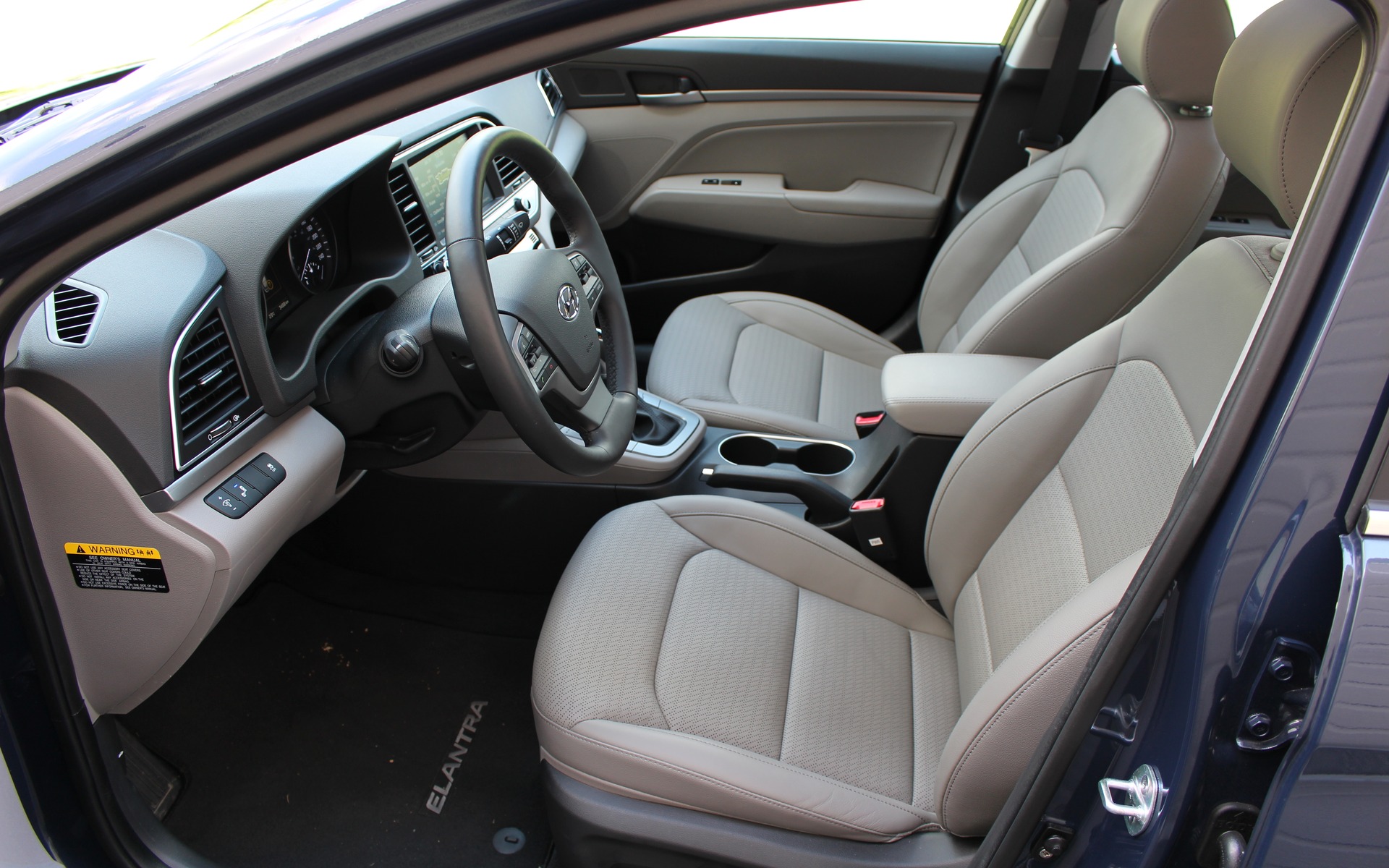
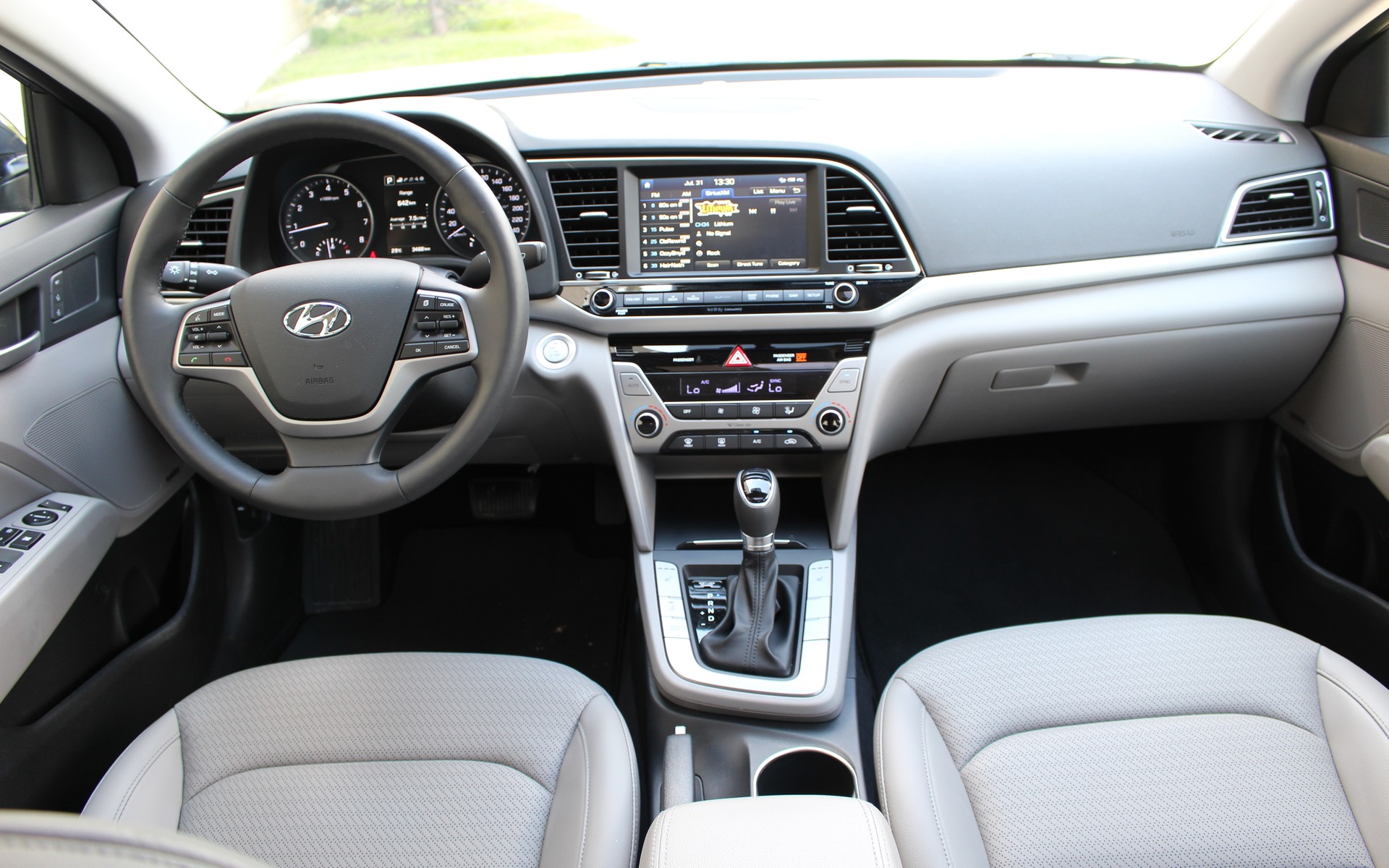
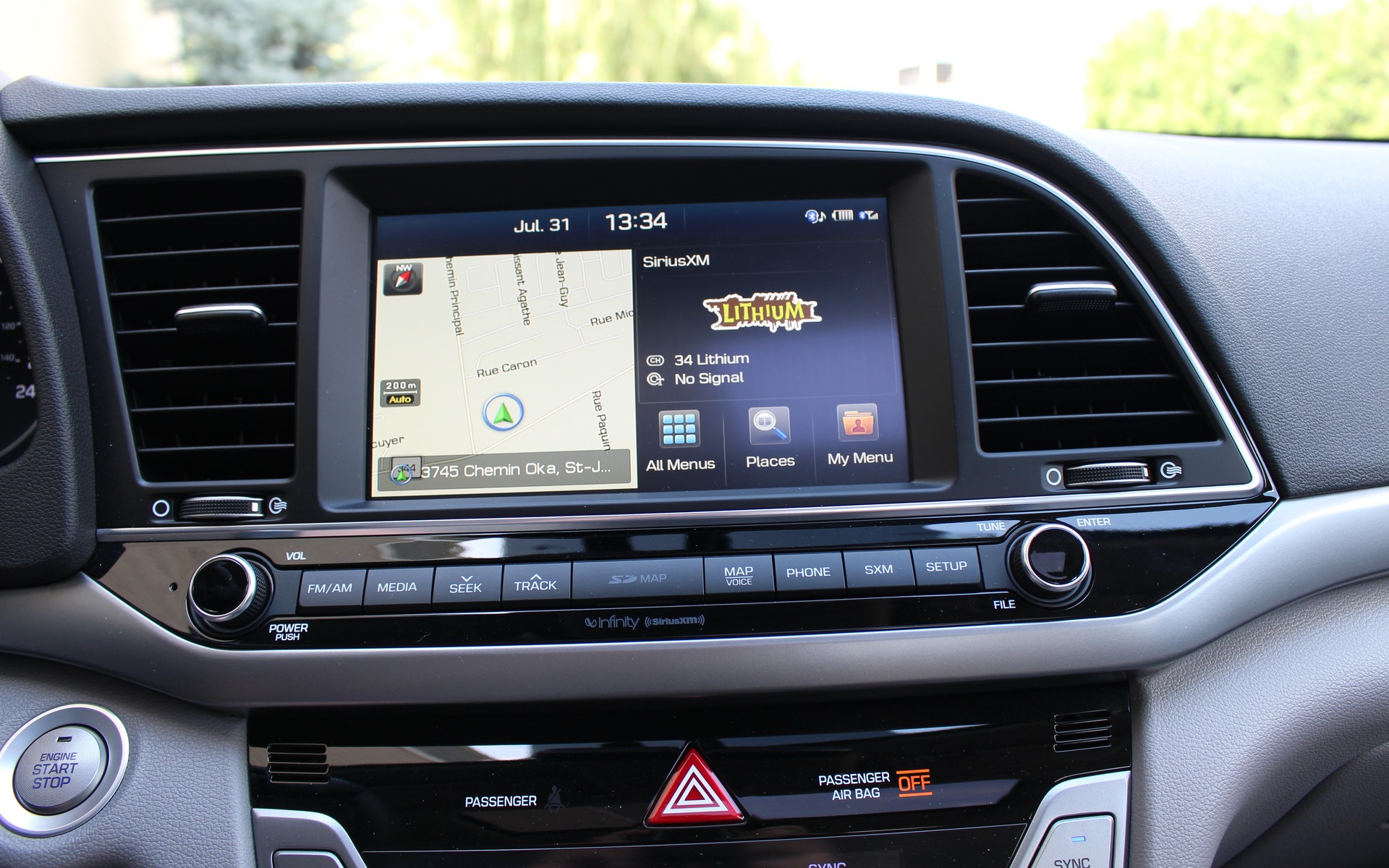
Overall, the interior design is clean and elegant, echoing the bodywork’s low-risk styling. The switchgear feels solid and substantial, while the infotainment screen is reactive, although some swiping functions aren’t all that easy to perform while we’re driving. Displaying the windshield wiper or headlight settings in the instrument panel while we’re adjusting them is a thoughtful touch, allowing us to keep our eyes on the road ahead.
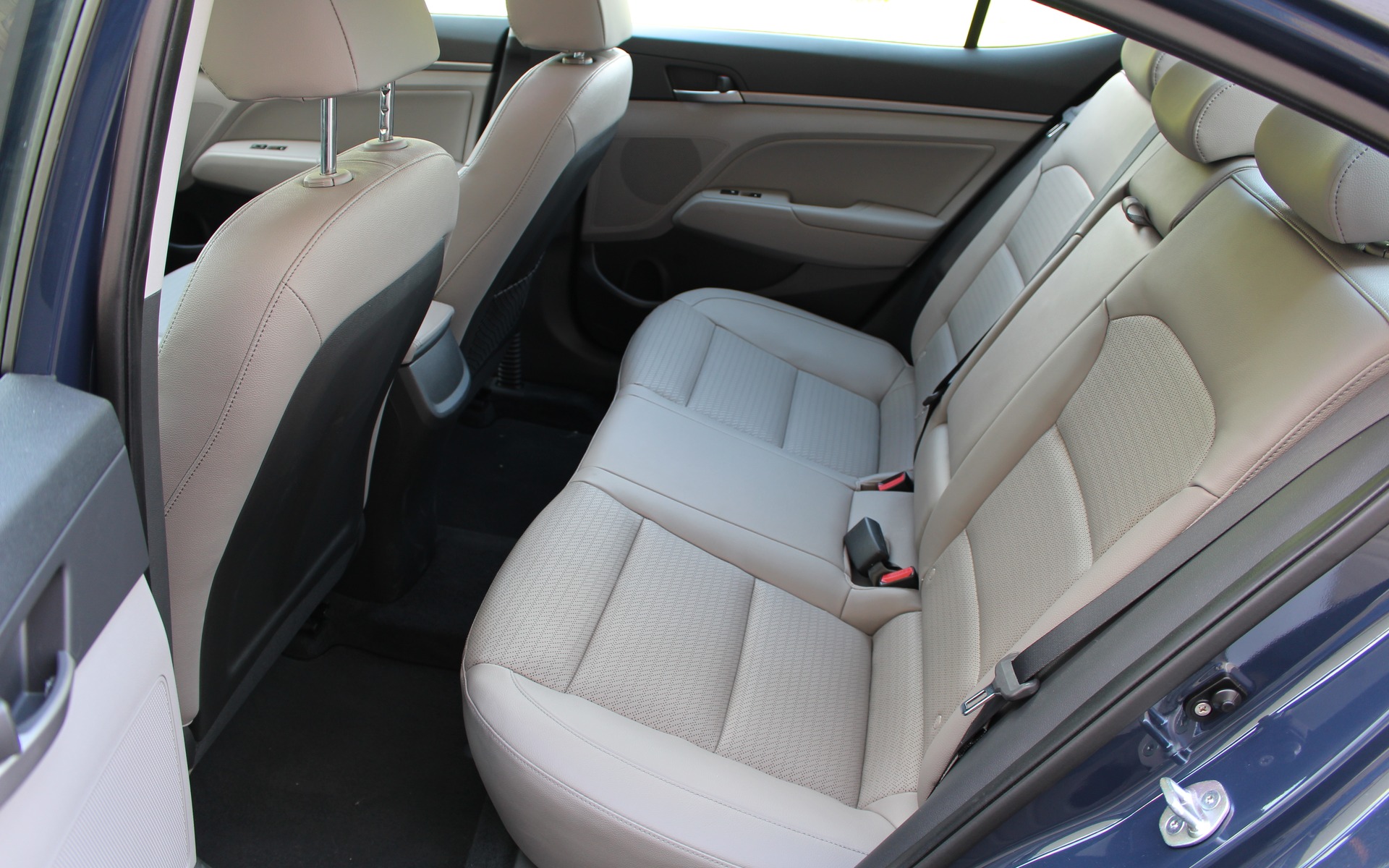
We also liked the Elantra’s supportive seats and good interior space, while the hump on the rear-seat floor is small, making it easier for three passengers to ride back there without squabbling. Too bad there are no rear-seat ventilation ducts at the back of the centre console, though. The trunk is big and so is its opening, and the 60/40 split folding rear seats have pull handles in the truck to make our life easier.
Cloth upholstery is obviously standard, while SE and Limited trims get leather. The base, $15,999 Elantra includes heated and height-adjustable front seats, a six-speaker stereo with USB port and keyless entry, but is otherwise pretty barebones with no wheel-mounted audio controls, no Bluetooth connectivity and no air conditioning. It’s a price leader version that only a few buyers will actually choose, while the LE automatic has a lot more features for its $18,499 MSRP, before freight and delivery charges.
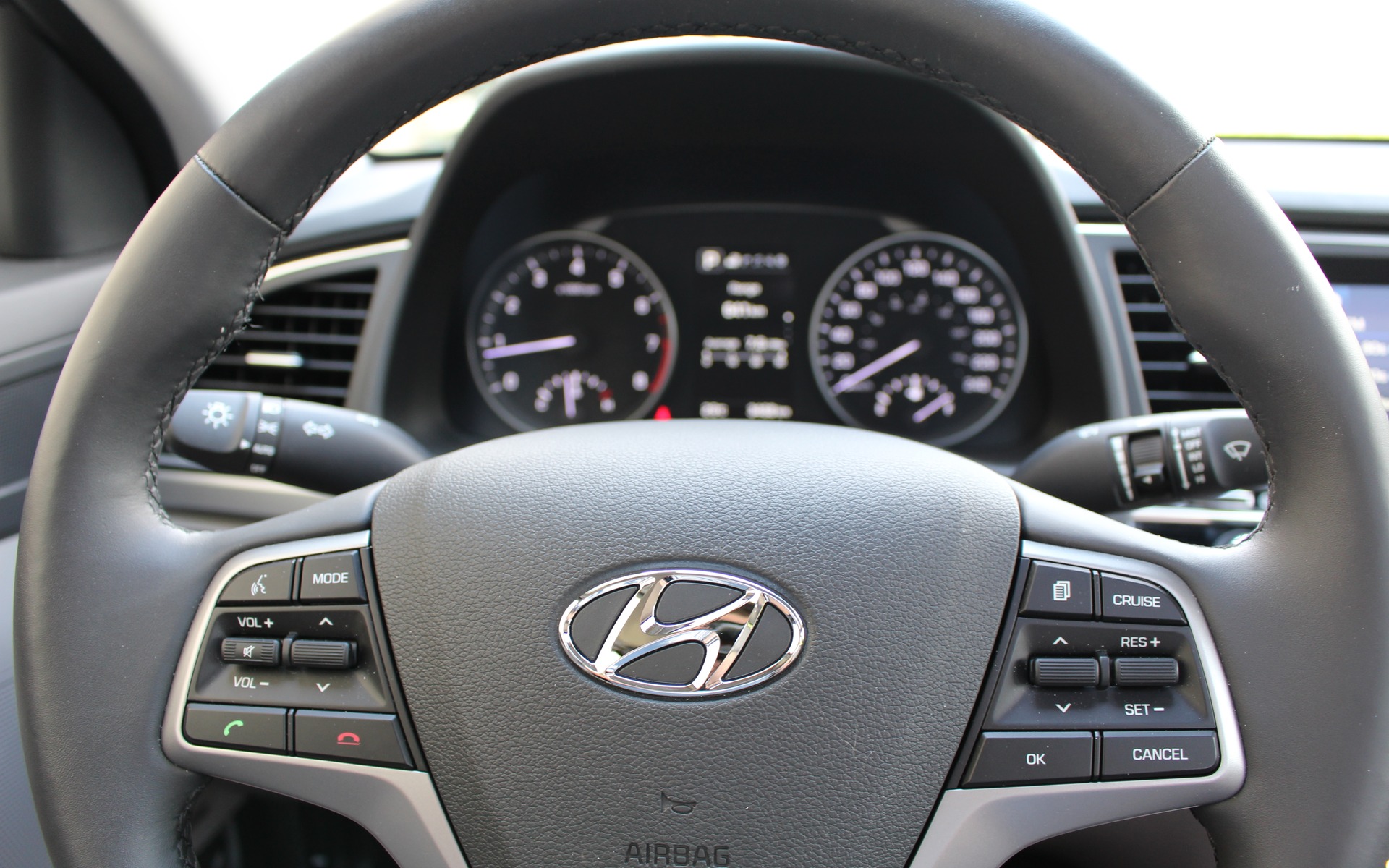
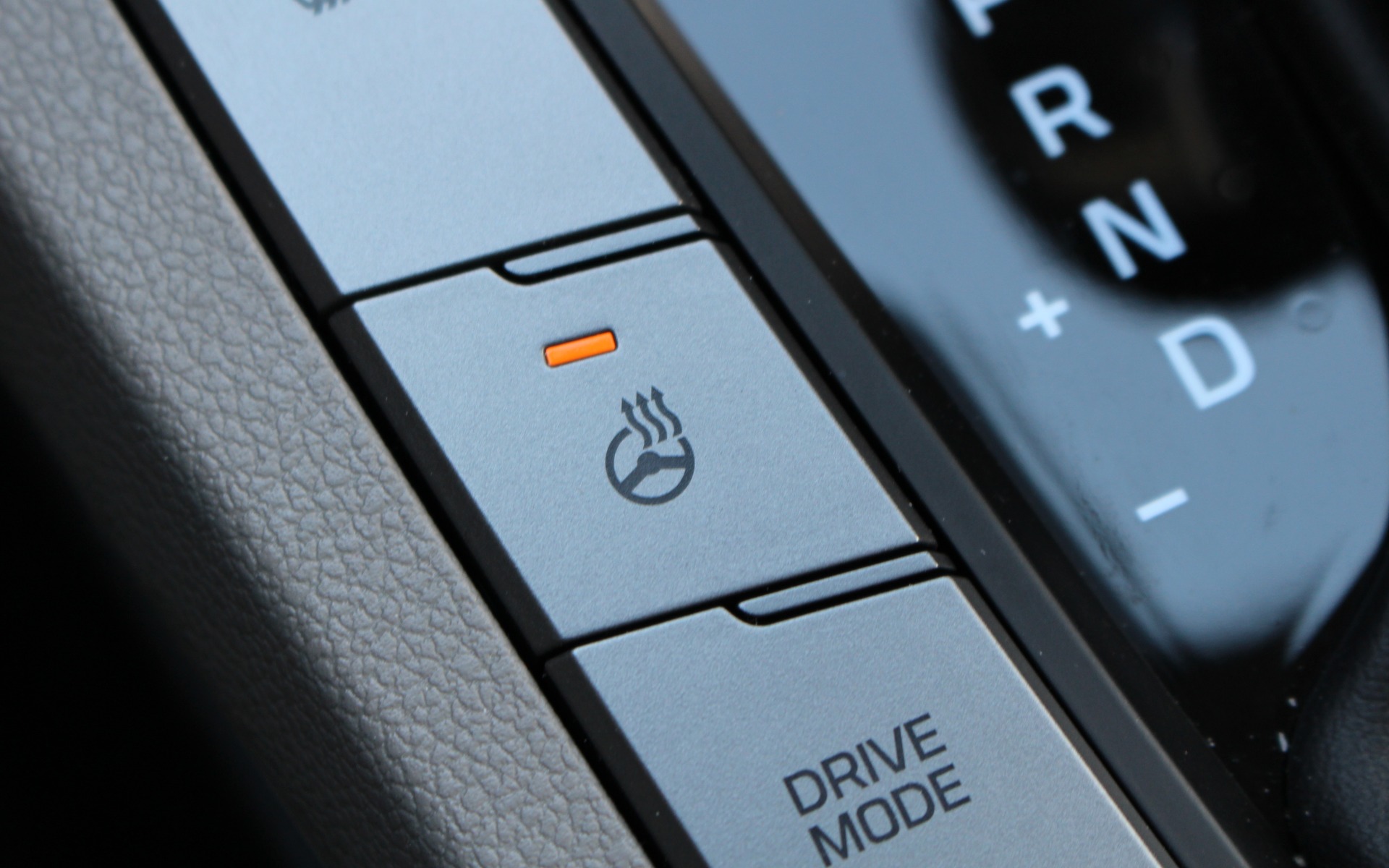
The volume seller is the 2017 Hyundai Elantra GL. At $20,349, it’s equipped with a heated and leather-wrapped wheel, blind spot detection with rear cross traffic alert, alloy wheels and a 7.0-inch touchscreen with Android Auto and Apple CarPlay integration. The Limited, Limited SE and Limited Ultimate variants are loaded with all the features we can now expect to find in compact sedans, including a slew of advanced safety features, and they obviously cost much more, but $29K is the most we can spend on one.
The new Elantra sedan isn’t a game-changer, and it doesn’t bring anything new to the compact-car segment. On the other hand, it does everything well, like it has been doing for a few years now. It looks smart, it makes its owners look smart and apart from the base trim level, it offers great bang for the buck. We see no reason why the Elantra won’t continue to sell well and retain its third-place ranking in Canada.
Article source: https://www.guideautoweb.com/en/articles/42576/2017-hyundai-elantra-hitting-the-mark-again/